Motion, Pace, and Points: What Actually Drives NFL Scoring - 8/6/2026
Three stats get thrown around constantly when people talk about "good offenses" — how much a team uses pre-snap motion, how many plays it runs per game, and how many points it scores. The assumption is usually that all three move together: motion-heavy, fast-paced teams score more. We pulled the real 2025 season numbers for all 32 teams and checked whether that's actually true.
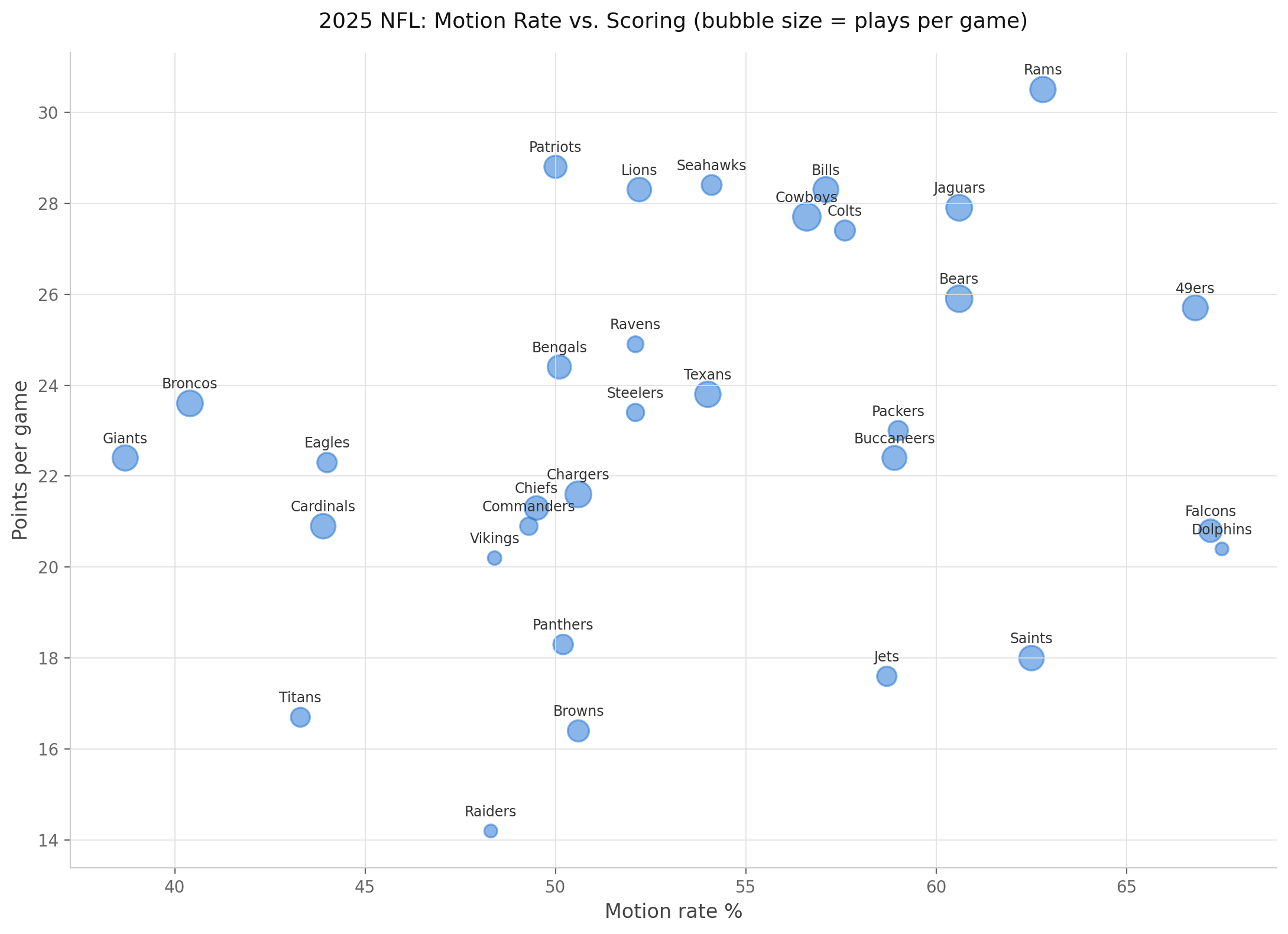
Plays per game had the clearest relationship with scoring. Across the league, teams that ran more offensive snaps per game scored more points, on average — a moderate, real statistical relationship (r = 0.47). That tracks intuitively: more snaps means more possessions, more chances to move the ball, and more opportunities for a play to end in the end zone. The Rams led the league in scoring at 30.5 points per game while running 63.9 plays per game — solidly above league average pace.
Motion rate told a messier story. The relationship between how often a team used pre-snap motion and how many points it scored was weak (r = 0.25) — present, but nowhere near as strong as most people assume. The clearest evidence: the three most motion-heavy offenses in football — the Dolphins (67.5%), Falcons (67.2%), and 49ers (66.8%) — did not translate that into top-tier scoring. The Dolphins and Falcons both finished in the bottom half of the league in points per game despite leading the league in motion usage.
Motion and pace, meanwhile, had almost nothing to do with each other (r = 0.10). A team's decision to use a lot of motion and a team's decision to play fast are essentially independent choices, not two versions of the same "aggressive offense" identity. The Cardinals ran the most plays per game in football (63.2) while sitting in the bottom half of the league in motion rate (43.9%) — proof those two things aren't the same strategy.
What this actually means: motion is a real tool, and offenses that use it well can get real value from it — but simply running a lot of motion isn't, by itself, a strong predictor of scoring. Tempo has a real, measurable connection to points on the board that motion usage alone doesn't. If you're evaluating an offense's actual scoring potential, plays-per-game is the more reliable signal of the two — not because motion doesn't matter, but because how many chances a team gives itself matters more.