Teams on the Rise: Who's Actually Projected to Score More in 2026 - 8/6/26
We pulled real 2025 offensive touchdown totals for every team and lined them up against current 2026 season projections to see who's actually expected to improve — not by vibes, but by the numbers.
Two important notes before the list. First, no sportsbook publishes a direct "team touchdown total" betting line — that market doesn't exist. What we're using instead is a real, dated analyst projection (Fantasy Football Index, published July 7, 2026), clearly labeled as a projection rather than a Vegas line. Second, and more important: the biggest "risers" on this list aren't necessarily teams anyone believes got dramatically better. Several of them are simply teams that scored so few touchdowns last year that almost any projection model expects them to move back toward the league average. That's a real statistical effect, not a bold prediction — worth knowing before you read too much into the order.
| Rank | Team | Projected Off. TDs |
|---|---|---|
| 1 | LA Rams | 56.1 |
| 2 | Buffalo | 55.3 |
| 3 | Detroit | 50.2 |
| 3 | Jacksonville | 50.2 |
| 5 | Cincinnati | 49.3 |
| 5 | San Francisco | 49.3 |
| 5 | New England | 49.3 |
| 8 | Baltimore | 47.6 |
| 8 | Green Bay | 47.6 |
| 8 | Chicago | 47.6 |
| 11 | Dallas | 45.9 |
| 12 | Denver | 45.1 |
| 13 | Philadelphia | 44.2 |
| 13 | Kansas City | 44.2 |
| 13 | Indianapolis | 44.2 |
| 16 | Seattle | 43.4 |
| 17 | NY Giants | 42.5 |
| 18 | LA Chargers | 41.7 |
| 19 | Washington | 40.8 |
| 20 | Pittsburgh | 40.0 |
| 21 | Tampa Bay | 39.1 |
| 21 | Minnesota | 39.1 |
| 21 | Atlanta | 39.1 |
| 24 | Houston | 37.4 |
| 24 | New Orleans | 37.4 |
| 26 | Arizona | 35.7 |
| 26 | Tennessee | 35.7 |
| 26 | Carolina | 35.7 |
| 29 | Miami | 34.0 |
| 30 | NY Jets | 33.2 |
| 31 | Cleveland | 32.3 |
| 32 | Las Vegas | 31.5 |
The Low-Bar Risers — Regression, Not Necessarily a Real Leap
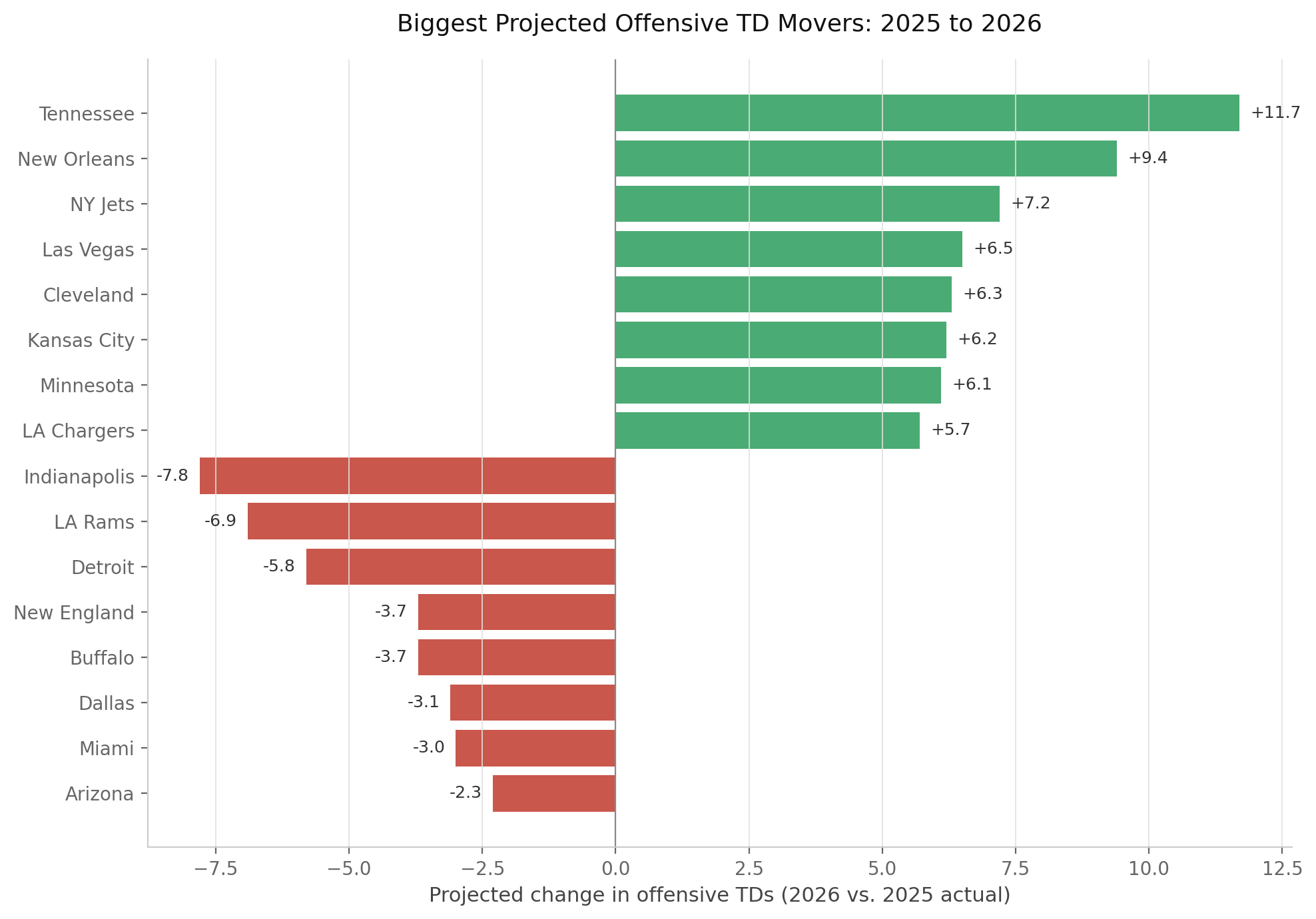
Tennessee (24 → 35.7 projected, +11.7), New Orleans (28 → 37.4, +9.4), the Jets (26 → 33.2, +7.2), Las Vegas (25 → 31.5, +6.5), and Cleveland (26 → 32.3, +6.3) top the list of biggest year-over-year increases. Every one of these teams finished in the bottom five in the league last year. A jump from "historically bad" to "still below average" isn't really a story about improvement — it's closer to the natural floor kicking back in.
The Risers That Actually Mean Something
Four teams stand out as real, competitive-relevance risers — not just bad teams bouncing off the bottom:
Kansas City (38 → 44.2, +6.2) — a real jump for a team that's typically an elite offense, suggesting the analyst expects a bounce-back year after a down 2025
Minnesota (33 → 39.1, +6.1) — solid, meaningful improvement projected for a middle-tier offense
LA Chargers (36 → 41.7, +5.7) — a legitimate step forward for a team that made real offseason additions
Houston (33 → 37.4, +4.4) — modest but real growth projected after a rough season
The Decliners — Regression Working the Other Direction
The flip side matters just as much. Indianapolis (52 → 44.2, -7.8), the Rams (63 → 56.1, -6.9), and Detroit (56 → 50.2, -5.8) top the projected declines — and for the same underlying reason as the risers, just reversed: these three had historically excellent scoring seasons in 2025, and the model expects some natural cooling. That doesn't mean these offenses are bad — the Rams' projected 56.1 would still rank among the league's better offenses even after the "decline." It's the same regression principle working in both directions.
New England and Buffalo (both -3.7) are worth a specific flag. Both offenses are projected down despite real reasons for optimism — Buffalo added weapons, and New England gets another year of Drake Maye's development plus a full season with A.J. Brown. Worth watching whether the season proves the projection too conservative here.
The Takeaway
Read a "biggest riser" list literally and you'd think Tennessee and New Orleans are the offenses to get excited about. They're not — they're just not going to be historically bad again. The real signal is in the smaller list: Kansas City, Minnesota, the Chargers, and Houston are the teams where a real projected improvement lines up with an offense that was already competitive. That's the difference between a stat moving and a team actually getting better.